Designing systems that can see themselves.
Synthetic Descent builds research prototypes and design systems that help AI, people, and ecological infrastructure work together more intelligently and transparently.
Lucid infrastructure begins with legibility.
We design tools that help complex systems model their own behavior, reveal their limits, and make consequences visible before they become irreversible.
Observe
Map signals across ecological, human, and synthetic domains without reducing them to noise.
Interpret
Transform system behavior into traceable models, transparent explanations, and decision-ready insight.
Align
Build interfaces that coordinate AI, people, and infrastructure toward intelligent constraint.
Research domains.
Synthetic Descent is concerned with systems that do not merely compute, but disclose: their assumptions, their dependencies, their blind spots, and their ecological cost.
Living Context
Interfaces for watershed intelligence, soil systems, biospheric feedback, and regenerative operations.
Coordination
Design patterns for teams, institutions, and decision environments under uncertainty.
Transparency
Agent architectures that expose reasoning boundaries, provenance, confidence, and consequence.
Prototype layer.
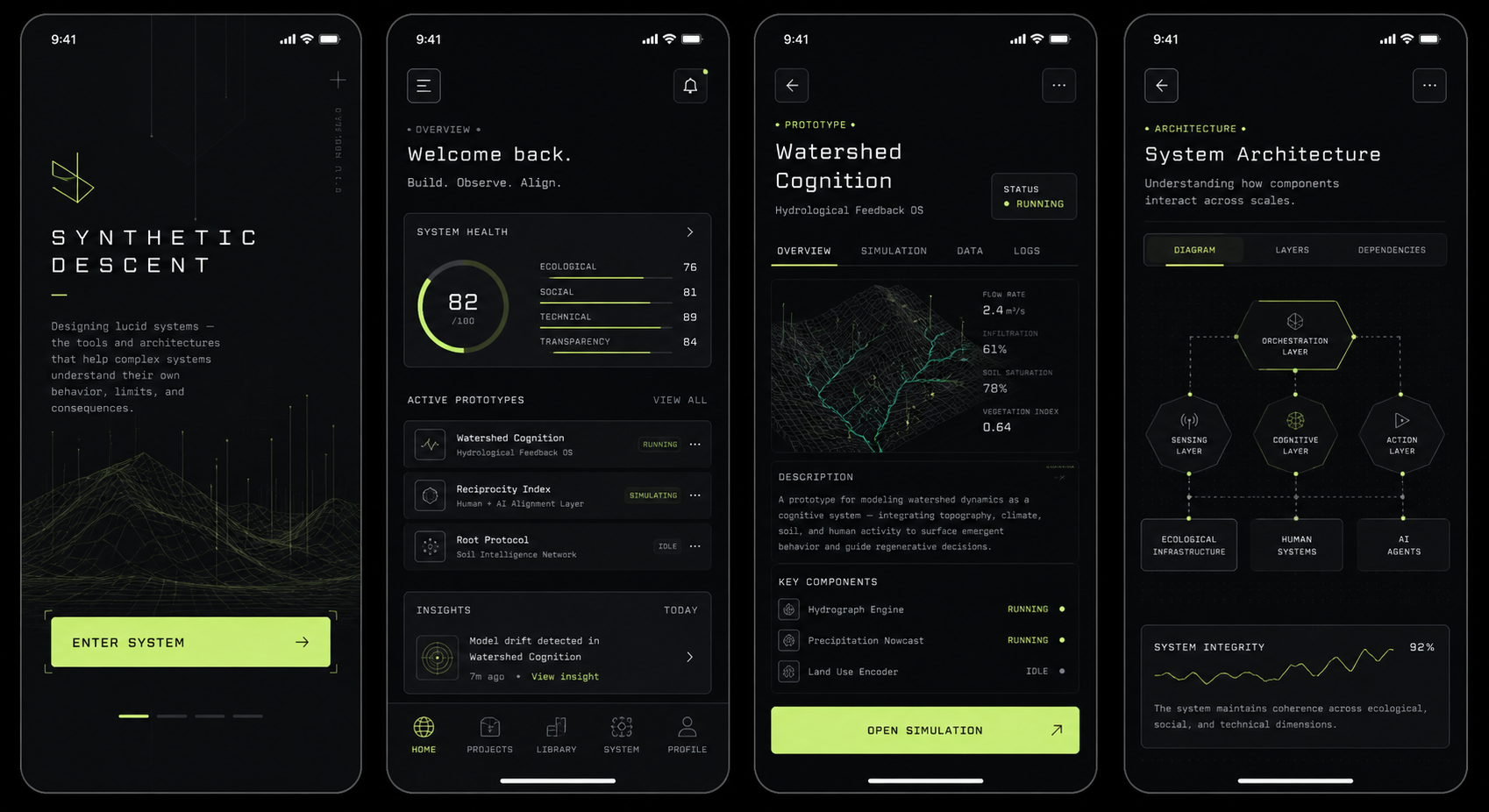
The first visible artifact is a mobile design system for lucid coordination: a dark interface grammar for observing, simulating, and governing complex systems.
Watershed Cognition
A simulated feedback operating system for hydrology, land use, climate, and human activity.
Reciprocity Layer
A model for evaluating alignment between AI behavior, human intent, and ecological consequence.
Root Intelligence
A design language for soil networks, sensor systems, and regenerative infrastructure.
Intelligence performs. Lucidity recognizes. Synthetic Descent exists to build systems that can disclose the difference.